The word
Before the music comes in, somebody names the intention of the evening. Every concert is preceded by a short introduction — most often by a Jesuit, such as Fr Jarek Naliwajko or Fr Przemysław Wysogląd.
Via · The path of the concerts
Every evening in this cycle has an intention of its own — and a programme of its own, grown out of it.
It is a contemporary form of the old Concerts Spirituels — walk them in order, towards the one that has not happened yet.
Step onto the path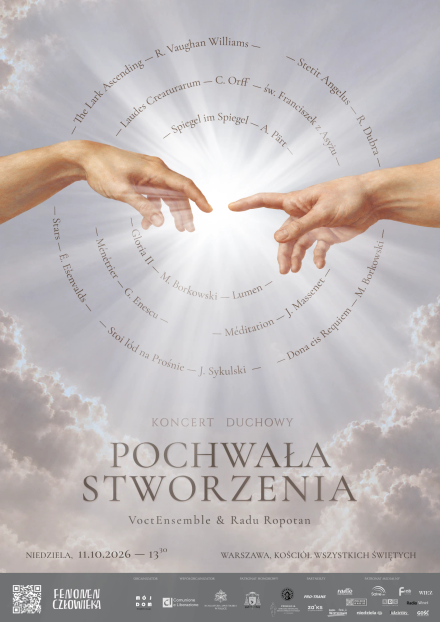
Image I · Incarnatio
An attempt to enter the mystery of the Incarnation: from Isaiah's prophecy to the Canticle of Simeon, in music from Sandström to Monteverdi.
Et egredietur virga de radice Iesse And there shall come forth a rod out of the stem of Jesse Is 11:1
Image II · Terra
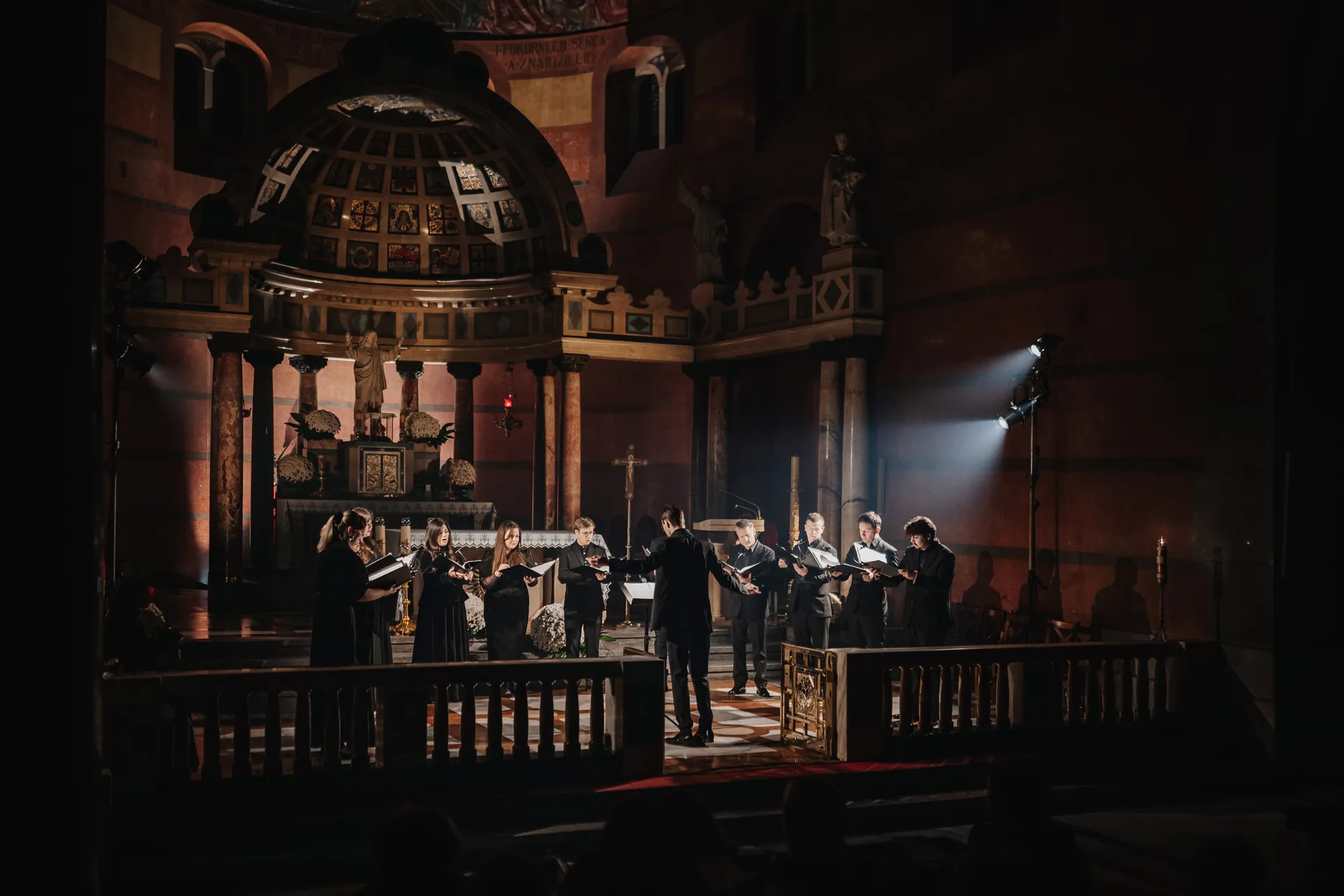
The mountains were this programme's breath. Twelve voices and the violin of Radu Ropotan led from sacred polyphony towards songs in which a landscape becomes the memory of a community.
Ad te clamamus, exsules filii Hevae To thee do we cry, poor banished children of Eve Salve Regina
Image III · Psalmi
A psalm is the place where one need not simplify oneself before God. Allegri's Miserere, divided into nine parts, was wound around the whole evening; between its penitential stanzas came psalms of thanksgiving, of wisdom and of joy in turn.
Miserere mei, Deus, secundum magnam misericordiam tuam Have mercy upon me, O God, after thy great goodness Ps 51
Image IV · Memoria
A tribute to those who gave their lives in defence of Ukraine, and a prayer for peace for those who carry the weight of the war onwards. At its climax, with the altarpiece of St Mary's Basilica opened, an organ improvisation on the Ukrainian anthem sounded.
Боже великий, єдиний, нам Україну храни Great and only God, preserve Ukraine for us Prayer for Ukraine
Image V · Lamentum
Faced with the suffering of the people of Gaza we chose the language of compassion, not of commentary. The programme led from Vivancos's Aeternam and the lament Vox in Rama, through prayers for peace by Pärt, Havrylets and Gjeilo and Lotti's image of the Passion, towards Shaw's refuge and Tavener's act of commendation.
Requiem aeternam dona eis, Domine, et lux perpetua luceat eis Eternal rest grant unto them, O Lord, and let perpetual light shine upon them Requiem Introit
The coming concert
Image VI · Laudes
The concert grows out of St Francis’s Laudes creaturarum, known in English as the Canticle of the Sun: in it the whole of creation is a road to the Creator. The programme leads from wonder at the world towards human frailty, towards change, suffering and death, and between the groups of works Pärt’s Spiegel im Spiegel returns from the gallery, the mirror of that relation. The whole road is closed by Dubra’s Stetit Angelus, the image of an angel censing the altar with the prayers of all the saints, sung in the church of All Saints.
Laudato si', mi' Signore, cum tucte le Tue creature Praised be You, my Lord, with all Your creatures St Francis's Canticle of the Sun
Nuntius · Invitations
One short letter before each concert: the place, the hour, the programme. Nothing else.
A Mass, a solemnity, a wedding: the programme is then shaped for the liturgy, not for an evening. These performances stand outside the cycle’s numbering.
Liturgia
Here the music served the liturgy. On the centenary of both Polish provinces of the Society of Jesus, the singing took its place within the rite, presided over by Archbishop Adrian Galbas, with the homily preached by Fr Arturo Sosa SJ.
When the opera fell silent in eighteenth-century Paris for the feast days, Concerts Spirituels were given in a hall of the Tuileries Palace — sacred music outside the frame of a service. We are returning to that tradition.
Before the music comes in, somebody names the intention of the evening. Every concert is preceded by a short introduction — most often by a Jesuit, such as Fr Jarek Naliwajko or Fr Przemysław Wysogląd.
The order of the pieces is part of the composition. The same note comes back beside every programme in the ensemble's notes: “order matters very much”.
Silence stays between the pieces. We ask for it plainly, in print in the programme — including the silence after the last chord.
The light has a score of its own: the fades and the cues are settled together with the programme. Ada Bystrzycka has watched over the lighting of many of these evenings.
Renaissance polyphony, the Baroque and contemporary minimalism stand side by side in one evening. We build the programme out of the tension between them.
The Sacred Heart and St Mary's basilicas in Kraków, St Anthony's in Rybnik, Łódź Cathedral, the shrine in Warsaw, the spa manor house in Szczawnica, the church in Niedzica. Every time, we composed the programme anew — for that place and that occasion. We will prepare a spiritual concert, the music of a liturgy or of a celebration.