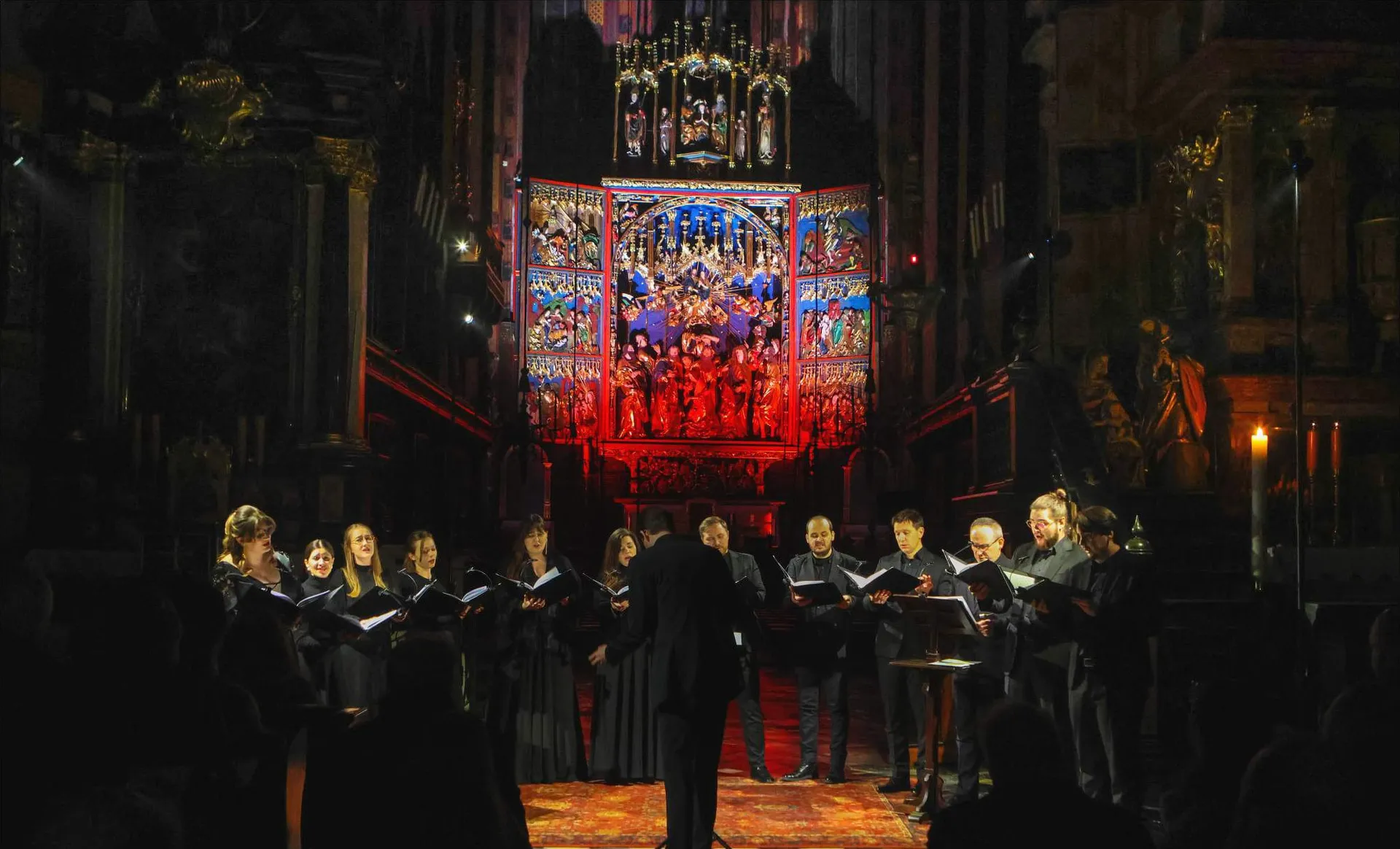
Image IV Memoria
Hymn to the Fallen
Боже великий, єдиний, нам Україну храни Great and only God, preserve Ukraine for us Prayer for Ukraine
Ante concentum The threshold of the evening
The twenty-second of February 2025, a Saturday, eight in the evening. St Mary's Basilica in Kraków, two days before the third anniversary of the full-scale invasion of Ukraine. Before the first word is spoken, the organ fills the church; then the archpriest of the basilica leads the congregation into prayer.
Reflectio Reflection
The concert is an expression of remembrance, of solidarity and of support for those the conflict has touched directly — families, friends, and also those who are still fighting for their freedom and their dignity.
VoctEnsemble · February 2025
Programma The concert programme
A prayer for peace: thirteen links and an encore
- Conductor
- Florent de Bazelaire
- Word and blessing
- ks. inf. dr hab. Dariusz Raś
- Cantor of the basilica
- M. Wasilewski-Kruk
- Organ
- Michał Piechnik · Krzysztof Michałek
The order here is a rite. The evening begins with the organ, and the first word spoken is in Ukrainian. Then the programme goes down to where mourning actually lives: to a litany for peace, to the rivers of Babylon on which the exiles hung up their instruments, and to a psalm that asks outright: how long? From there it leads through two prayers for shelter and through a burial, as far as the wordless hymn the evening is named after. Only at the end is it permitted to speak of light, and then the one thing that cannot be sung takes place: the altarpiece is opened.
-
Introitus Entrance
First the space alone: the great organ of St Mary's Basilica. The first word spoken this evening is a prayer in Ukrainian.
- 01
J. S. Bach · 1685–1750
Fantazja i fuga g-moll, BWV 542
About the work
The “great” fantasia and fugue in G minor, associated with Bach's visit to Hamburg in 1720 — the same visit during which he improvised for half an hour on the chorale “An Wasserflüssen Babylon”, and the aged Reincken is said to have remarked that he had thought this art already dead. The fantasia is almost operatic: recitative, suspensions, a chromaticism with no floor to it. Krzysztof Michałek played it as the entrance music, before the first word of the evening was spoken; the rivers of Babylon will return here shortly, in Palestrina.
- 02
John Rutter · ur. 1945
A Ukrainian Prayer
Боже великий, єдиний, нам Україну храни Great and only God, preserve Ukraine for us (Prayer for Ukraine · O. Konysky, 1885)
Text and translation
Rutter wrote it in the first weeks after the Russian invasion of 2022 and made it available to choirs free of charge, asking in return for support for the victims of the war. The text is Oleksandr Konysky's “Prayer for Ukraine”, which Mykola Lysenko set in 1885; it is sung to this day as Ukraine's spiritual anthem. The first word of this evening is therefore a plea in the language of those it prays for.
Боже великий, єдиний, нам Україну храни, волі і світу промінням Ти її осіни. Світлом науки і знання нас, дітей, просвіти, в чистій любові до краю Ти нас, Боже, зрости. Молимось, Боже єдиний, нам Україну храни, всі свої ласки й щедроти Ти на люд наш зверни.
Great and only God, preserve Ukraine for us, with the ray of freedom and of light do thou illumine her. With the light of learning and of knowledge illumine us, thy children, and in pure love of our land bring us up, O God. We pray to thee, O only God, preserve Ukraine for us, turn all thy graces and thy bounty upon our people.
- Introduction to the prayer · Mgr Dariusz Raś
-
Luctus Mourning
The prayer starts from what is: a litany for peace, the rivers of Babylon on which the exiles hung up their instruments, and a psalm that asks outright: how long?
- 03
Siergiej Rachmaninow · 1873–1943
Ektenia Pokoju, op. 31 nr 1
from the Liturgy of St John Chrysostom · the choir's responses
Text and translation
The great litany opens the Orthodox Divine Liturgy; it is also called the litany of peace, because the deacon's first petitions are for the peace from on high and for the peace of the whole world. The choir answers them with two sentences only. Rachmaninov wrote his Liturgy of St John Chrysostom in 1910 in under three weeks. It was his first church work; seven years later he left Russia for good. That evening his petition for the peace of the whole world sounded immediately after the prayer for Ukraine.
Господи, помилуй. Тебе, Господи.
Lord, have mercy. To thee, O Lord.
- 04
Giovanni P. da Palestrina · 1525–1594
Super flumina Babylonis
Super flumina Babylonis, illic sedimus et flevimus By the waters of Babylon we sat down and wept (Ps 137 (136):1–2)
Text and translation
A motet for four voices published in 1581. Psalm 137, the song of the exiles who laid music aside by the rivers of Babylon: they hung their instruments on the willows, because they could not sing the Lord's song in a strange land. Palestrina leads the four voices with complete calm; the mourning here is in what has fallen silent.
Super flumina Babylonis, illic sedimus et flevimus, dum recordaremur tui, Sion. In salicibus in medio eius suspendimus organa nostra.
By the waters of Babylon — there we sat down and wept, when we remembered Sion. Upon the willows of that land we hanged up our instruments.
- 05
Dieterich Buxtehude · 1637–1707
Ach Herr, mich armen Sünder, BuxWV 178
an organ setting of the chorale · a paraphrase of Psalm 6
About the work
An organ setting of the chorale on the melody the world now knows as the Passion chorale, “O Haupt voll Blut und Wunden”, the one Bach called upon five times in the St Matthew Passion. The chorale text is itself a paraphrase of Psalm 6, the first of the penitential psalms, in which the soul asks outright: how long? Here there were no words. Michał Piechnik played them on the organ; anyone who knows the melody heard them.
-
Lorica Breastplate
Two prayers for shelter: the breastplate of St Patrick, in which Christ stands on every side, and a hymn in which the faithful ask for strength, because “the fierce battle” presses upon them.
- 06
Arvo Pärt · ur. 1935
The Deer's Cry
from “The Breastplate of St Patrick” (Lorica)
Text and translation
Pärt wrote it to a commission from the Irish Louth Contemporary Music Society. The text is a fragment of “The Breastplate of St Patrick”, the prayer the saint is said to have recited as he went to convert the king of Tara; the king's men then saw, instead of travellers, a herd of deer — hence the second name: the deer's cry. It is a prayer of protection: Christ places himself on every side of the one who speaks. Pärt, in his tintinnabuli, repeats it the way a prayer one genuinely needs is repeated.
Christ with me, Christ before me, Christ behind me, Christ in me, Christ beneath me, Christ above me, Christ on my right, Christ on my left, Christ when I lie down, Christ when I sit down, Christ in me, Christ when I arise, Christ in the heart of every man who thinks of me, Christ in the mouth of everyone who speaks of me, Christ in every eye that sees me, Christ in every ear that hears me, Christ with me.
- 07
Ēriks Ešenvalds · ur. 1977
O salutaris hostia
O salutaris Hostia, quae caeli pandis ostium O saving Victim, opening wide the gate of heaven · from the hymn Verbum supernum prodiens
Text and translation
The same hymn that sounded in “The Call of the Mountains”: the last two stanzas of St Thomas Aquinas's Verbum supernum prodiens, sung at the exposition of the Blessed Sacrament. Here, though, something else is audible in it: “bella premunt hostilia, da robur, fer auxilium” — the fierce battle presses upon thy faithful, give strength, send help. A thirteenth-century eucharistic hymn speaks of war outright; it is the only text of the evening the ensemble printed in the programme in full.
O salutaris Hostia, quae caeli pandis ostium: bella premunt hostilia, da robur, fer auxilium. Uni trinoque Domino sit sempiterna gloria, qui vitam sine termino nobis donet in patria. Amen.
O saving Victim, opening wide the gate of heaven to man below; our foes press on from every side, thine aid supply, thy strength bestow. To thy great name be endless praise, immortal Godhead, One in Three; O grant us endless length of days in our true native land with thee. Amen.
-
Exsequiae At the grave
Four links of a burial: the flight of angels over the grave, a hymn to the fallen without a single word, a summons to the soul not to be afraid, and a plea for rest.
- 08
John Tavener · 1944–2013
Song for Athene
text: Mother Thekla · Shakespeare and the Orthodox funeral service
Text and translation
Tavener wrote it after the death of Athene Hariades, a young actress and a friend of the family, who was killed in a cycling accident. The text was assembled by Mother Thekla, an Orthodox nun and for many years the composer's collaborator: she interweaves Horatio's words from “Hamlet” — “may flights of angels sing thee to thy rest” — with the Orthodox funeral service. Beneath the choir a motionless drone of basses runs throughout: the ison. The world heard the piece in 1997, when the coffin of Diana, Princess of Wales, was carried out of Westminster Abbey to its sound.
Alleluia. May flights of angels sing thee to thy rest. Alleluia. Remember me, O Lord, when you come into your kingdom. Alleluia. Give rest, O Lord, to your handmaid, who has fallen asleep. Alleluia. The Choir of Saints have found the well-spring of life, and door of paradise. Alleluia. Life: a shadow and a dream. Alleluia. Weeping at the grave creates the song: Alleluia. Alleluia. Come, enjoy rewards and crowns I have prepared for you.
- 09
John Williams · ur. 1932
Hymn to the Fallen
from the score of the film “Saving Private Ryan” · choir without words
About the work
From the score of Steven Spielberg's “Saving Private Ryan”. The choir does not sing a single word in it: pure vocalise. Williams wrote it not for a particular scene but as a hymn for the fallen. Without names and without a language, and so without borders. The evening took its name from this piece.
- 10
Jean Sibelius · 1865–1957
Be Still My Soul · hymn z Finlandii, op. 26
words: K. von Schlegel (1752), English translation by J. Borthwick · stanza III
Text and translation
The melody comes from the finale of the tone poem Finlandia, which Sibelius wrote in 1899, when tsarist Russia curtailed Finland's autonomy and imposed censorship on the Finnish press. The piece was then performed under invented titles to get round the ban; it became the song of resistance of a nation that did not yet have a state. Katharina von Schlegel's hymn of 1752, in Jane Borthwick's English translation, was later fitted to that melody: be still, my soul. So at a concert for Ukraine's fallen, a Finnish melody of freedom sounded to words of consolation.
Be still, my soul: the hour is hastening on when we shall be forever with the Lord, when disappointment, grief, and fear are gone, sorrow forgot, love's purest joys restored. Be still, my soul: when change and tears are past, all safe and blessed we shall meet at last.
- 11
Gabriel Fauré · 1845–1924
Pie Jesu · z Requiem op. 48
Pie Jesu Domine, dona eis requiem Merciful Lord Jesus, grant them rest · from the Requiem op. 48
Text and translation
The fourth and only solo movement of Fauré's Requiem, written for a boy's voice. Across his whole requiem Fauré gave up the Dies irae sequence, which in other settings takes up the most room: there is no judgement here and no terror. The work has been called a “lullaby of death”; the composer did not argue, that was how he saw death. The text is two sentences: have mercy, and grant them rest.
Pie Jesu Domine, dona eis requiem, dona eis requiem sempiternam.
Merciful Lord Jesus, grant them rest, grant them rest everlasting.
-
Conflabunt gladios suos in vomeres: nec exercebuntur ultra ad proelium.
They shall beat their swords into plowshares; neither shall they learn war any more.
Is 2:4 -
Lux Light
Only now is it permitted to speak of light, and then the altarpiece is opened.
- 12
Edward Elgar · 1857–1934
Lux aeterna (Nimrod) · oprac. J. Cameron
Lux aeterna luceat eis, Domine Let light eternal shine upon them, O Lord · the communion of the Requiem Mass
During this piece the Veit Stoss altarpiece was opened
Text and translation
Nimrod is the ninth of the Enigma Variations: a portrait of August Jaeger, the publisher and friend who, at a moment of doubt, persuaded Elgar not to stop writing. Jäger is German for “hunter”, and Nimrod was the hunter of the Bible: hence the name. Britain plays this music over graves, every year at the Cenotaph in London on Remembrance Sunday. John Cameron set the communion of the Requiem Mass beneath it: light eternal.
Lux aeterna luceat eis, Domine, cum sanctis tuis in aeternum, quia pius es.
Let light eternal shine upon them, O Lord, with thy saints for ever, for thou art merciful.
- 13
Michał Piechnik
Impresja organowa na temat „Szcze ne wmerła Ukrajiny”
the anthem of Ukraine · words: P. Chubynsky (1862), melody: Fr M. Verbytsky
About the work
The anthem of Ukraine: words by Pavlo Chubynsky of 1862, melody by Fr Mykhailo Verbytsky, a Greek Catholic priest — “Ukraine has not yet perished, nor her glory, nor her freedom”. The titular organist of St Mary's Basilica improvised on the theme with the altarpiece already open. From the tower of the same church a trumpet call is played every hour, breaking off mid-note in memory of an invasion.
- Blessing · Mgr Dariusz Raś
- bis
Edward C. Bairstow · 1874–1946
I sat down under his shadow
from the Song of Songs (Song 2:3–4)
Text and translation
Bairstow was organist of York Minster for thirty-three years; this short anthem is usually sung after communion, and its text comes from the Song of Songs. After an evening that closed with the anthem of a nation at war, the last word belongs to a different banner.
I sat down under his shadow with great delight, and his fruit was sweet to my taste. He brought me to the banqueting house, and his banner over me was love.
Besides the organ works listed in the programme, Michał Piechnik, titular organist of St Mary's Basilica, improvised between the links of the evening; in its announcement the ensemble called these interludes “a parallel narration, giving substance to the tragic face of war”.
The original texts follow the concert programme and the books they come from; the printed programme of the evening carried them abridged. The English of the hymns, antiphons and biblical passages follows the traditional versions — the Book of Common Prayer and the Authorised Version, and Edward Caswall's of 1849 for the hymn of St Thomas Aquinas — and the remaining translations are our own.
This is the first time we have taken part in a project which, beyond its spiritual dimension, speaks so directly to the greatest of human aspirations — freedom and self-determination. We want this concert to be not only an act of remembrance, but also a gift of solace to those who have suffered loss, and an expression of our solidarity with the Ukrainian people.
Anna Kaczka-Marcisz manager of VoctEnsemble, from the announcement of the concert
Imagines Images of the evening
Photographs: Andrzej Płachetko · the ensemble's own archive
Images from every evening