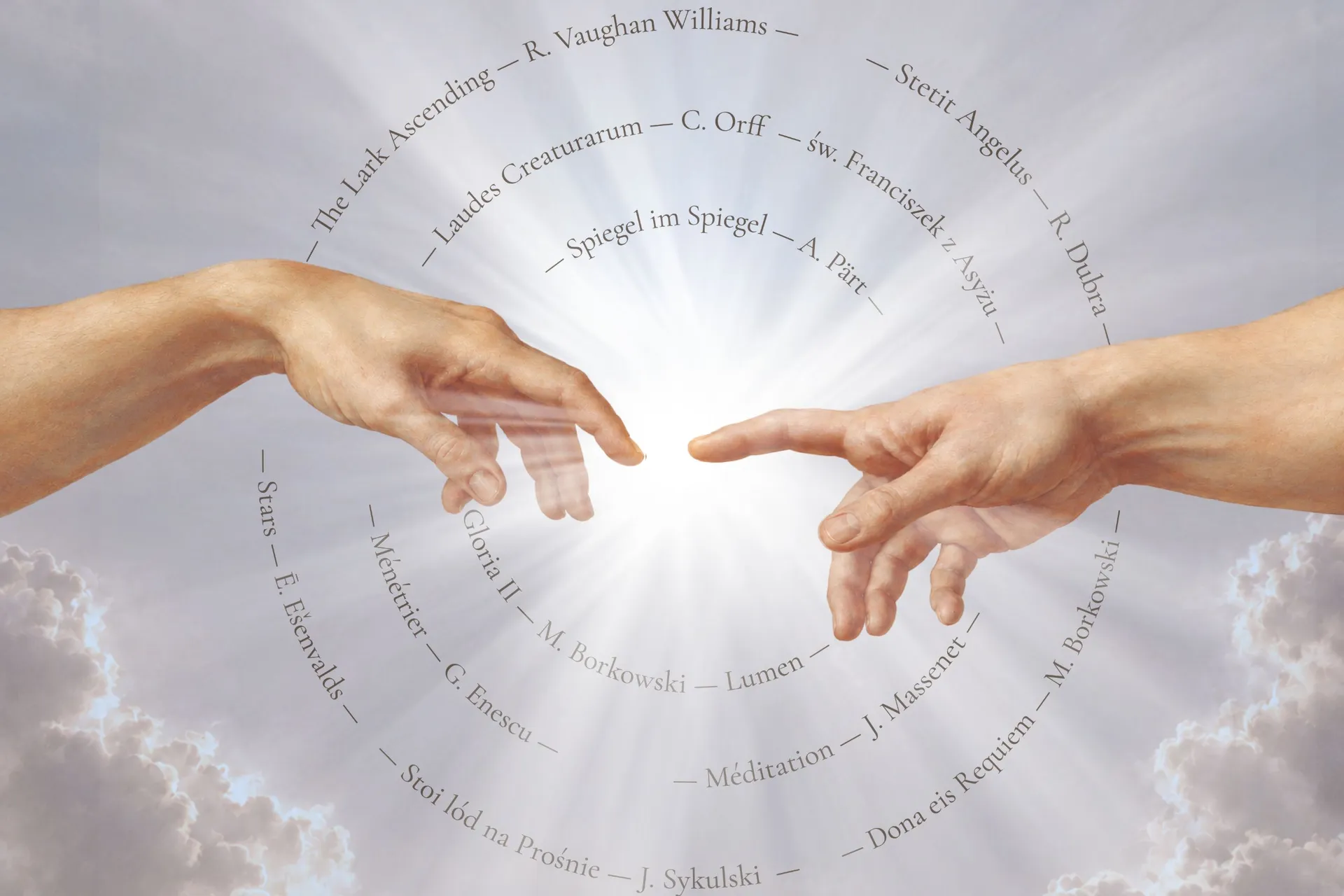
The coming concert
Image VI Laudes
In Praise of Creation
Laudato si', mi' Signore, cum tucte le Tue creature Praised be You, my Lord, with all Your creatures St Francis's Canticle of the Sun
Ianua Coming in
St Francis’s Canticle of the Sun greets the sun, the wind, the water and the fire as its own kin, and at the end greets death on the same terms. The programme follows that road: from light towards what is fragile in us, and further — to where the praise of creation becomes the prayer of all the saints, in the church that bears their name.
- When
- 11 October 2026 · 13:30–14:30
- Where
- Kościół Wszystkich Świętych, Warszawa Upper church pl. Grzybowski 3/5, Warszawa
- Admission
- Free admission
Fenomen człowieka
Three days of exhibitions, workshops and conversations; this concert closes them. The festival is run by the Mój Dom hospice foundation, which accompanies people with ALS and their families. This year's edition reads the human through beauty: the beauty of values and of relationships, the beauty of nature and of sound, and the beauty that stays even in pain. This programme descends towards that last one.
The festival's site ↗Ante concentum The threshold of the evening
A Sunday afternoon on plac Grzybowski. Above the portal of the church of All Saints a verse of the psalm is cut into the stone: “Praise the Lord in His saints”. The concert begins under that sentence already, and ends on a sentence of the same family — about an angel censing the altar with prayer.
Reflectio Reflection
The antiphon Dubra sets arranges words from the Book of Revelation: “the smoke of the incense went up with the prayers of the saints before God”. The last sentence of this road is therefore sung in the church that bears exactly that name — All Saints.
Programma The concert programme
Ten works and one mirror
- Conductor
- Florent de Bazelaire
- Violin
- Radu Ropotan
The order descends from praise and light: Borkowski's Gloria II and Lumen open the evening, and immediately after them comes Carl Orff's Laudes creaturarum, which sets St Francis's Canticle of the Sun directly. From there the programme moves from the cosmic image of creation towards the human: Massenet's Méditation, bound in the opera to the inward change of Thaïs; Ešenvalds's night sky; Vaughan Williams's lark, rising towards the light; Sykulski's frozen Prosna and Enescu's village fiddler. At the end come Borkowski's Dona eis requiem and Dubra's angel at the altar. Between the groups of works Pärt's Spiegel im Spiegel returns, played from the gallery on the organ as the musical mirror of the relation between creation and its Creator.
- Spiegel im Spiegel · Arvo Pärt · 5× through the evening
- 01
Marian Borkowski · ur. 1934
Gloria II
Borkowski has three works in this programme; the first opens it on one word: glory.
About the work
His sacred music usually takes a single Latin word and builds the whole piece out of it: in planes of sound, in extreme registers and in repetition, not in melody.
- 02
Marian Borkowski
Lumen
After praise comes the thing by which anything at all can be seen.
- Spiegel im Spiegel · Arvo Pärt
- 03
Carl Orff · 1895–1982
Laudes creaturarum
Everything the rest of the programme touches one at a time passes through here at once.
Text and translation
The whole Canticle, in the Umbrian original of the first half of the thirteenth century in which Francis composed it: the sun, the moon and the stars, wind, water, fire, mother earth, those who forgive, and sister death. Orff set it in 1954, in the collection Concento di voci. He carries the text in recitative, close to speech and on the rhythm of the syllables, so the whole of it passes in one unbroken span.
Altissimu, onnipotente, bon Signore, Tue so le laude, la gloria e l'honore et onne benedictione. Ad Te solo, Altissimo, se konfano et nullu homo ène dignu Te mentovare. Laudato si', mi' Signore, cum tucte le Tue creature, spetialmente messor lo frate sole, lo quale è iorno et allumini noi per lui; et ellu è bellu e radiante cum grande splendore: de Te, Altissimo, porta significatione. Laudato si', mi' Signore, per sora luna e le stelle: in celu l'ài formate clarite et pretiose et belle. Laudato si', mi' Signore, per frate vento et per aere et nubilo et sereno et onne tempo, per lo quale a le Tue creature dài sustentamento. Laudato si', mi' Signore, per sor'aqua, la quale è multo utile et humile et pretiosa et casta. Laudato si', mi' Signore, per frate focu, per lo quale ennallumini la nocte: ed ello è bello et iocundo et robustoso et forte. Laudato si', mi' Signore, per sora nostra matre terra, la quale ne sustenta et governa, et produce diversi fructi con coloriti flori et herba. Laudato si', mi' Signore, per quelli ke perdonano per lo Tuo amore et sostengo infirmitate et tribulatione. Beati quelli ke 'l sosterranno in pace, ka da Te, Altissimo, sirano incoronati. Laudato si', mi' Signore, per sora nostra morte corporale, da la quale nullu homo vivente po' skappare. Guai a quelli ke morrano ne le peccata mortali; beati quelli ke trovarà ne le Tue sanctissime voluntati, ka la morte secunda no 'l farrà male. Laudate et benedicete mi' Signore et rengratiate e serviateli cum grande humilitate.
Most High, all-powerful, good Lord, Yours are the praises, the glory, the honour and every blessing. To You alone, Most High, do they belong, and no man is worthy to speak Your name. Praised be You, my Lord, with all Your creatures, and first of all Sir Brother Sun, who is the day, and by whom You give us light; he is beautiful and radiant in great splendour — of You, Most High, he bears the likeness. Praised be You, my Lord, for Sister Moon and the stars: in heaven You formed them, bright and precious and fair. Praised be You, my Lord, for Brother Wind, for the air and the clouds, for fair weather and all weather, by which You give Your creatures their keeping. Praised be You, my Lord, for Sister Water, who is very useful and humble and precious and chaste. Praised be You, my Lord, for Brother Fire, by whom You light up the night; and he is beautiful and merry and robust and strong. Praised be You, my Lord, for our Sister Mother Earth, who sustains and governs us, and brings forth diverse fruits with coloured flowers and grass. Praised be You, my Lord, for those who forgive for love of You and bear infirmity and tribulation. Blessed are those who endure them in peace, for by You, Most High, they will be crowned. Praised be You, my Lord, for our Sister Bodily Death, from whom no living man can escape. Woe to those who die in mortal sin; blessed are those she finds doing Your most holy will, for the second death will do them no harm. Praise and bless my Lord, and give Him thanks, and serve Him with great humility.
- 04
Jules Massenet · 1842–1912
Méditation z opery Thaïs
The first interior of the afternoon: one that is turning as we listen.
About the work
An interlude between the scenes of the opera's second act: in Thaïs it is the moment when the title character, a courtesan of Alexandria, decides to change her life. The whole transformation happens without a single word, in the violin part.
- 05
Ēriks Ešenvalds · ur. 1977
Stars
text: Sara Teasdale
Straight after the interior, the sky, and a human being standing under it: the question of our place in creation begins here.
Text and translation
A poem by the American poet Sara Teasdale about a solitary night beneath the stars. To the choir Ešenvalds added glass harmonicas — tuned glasses played with a wet finger — so that they would sound like a shimmer.
Alone in the night on a dark hill with pines around me spicy and still, and a heaven full of stars over my head, white and topaz and misty red; myriads with beating hearts of fire that aeons cannot vex or tire; up the dome of heaven like a great hill, I watch them marching stately and still, and I know that I am honored to be witness of so much majesty.
- Spiegel im Spiegel · Arvo Pärt
- 06
Ralph Vaughan Williams · 1872–1958
The Lark Ascending
text: George Meredith · arr. for violin and choir: Paul Drayton
The highest point: the lark rises until it is lost in the light. From here everything descends.
Text and translation
A pastoral tone poem for violin, written in 1914 and revised in 1920; it waited six years for its first performance because the war had broken out. Its inspiration was George Meredith's poem about a lark rising towards the sky; the melodic line rises and falls in imitation of the flight. Paul Drayton rewrote the piece for violin and choir, so that Meredith's words — in the original only written above the notes — can here actually be heard.
He rises and begins to round, he drops the silver chain of sound, of many links without a break, in chirrup, whistle, slur and shake. For singing till his heaven fills, 'tis love of earth that he instils, and ever winging up and up, our valley is his golden cup and he the wine which overflows to lift us with him as he goes. Till lost on his aerial rings in light, and then the fancy sings.
- 07
Jacek Sykulski · ur. 1964
Stoi lód na Prośnie
a song in a folk idiom · words written to an existing vocalise
The Canticle calls the earth our sister, the one who sustains us. Here she sustains us only as long as the river runs.
Text and translation
Sykulski wrote it to a commission from Agnieszka Franków-Żelazny for the Polish National Youth Choir: as a vocalise, without words. Something was missing from it, though — “the piece carried no message”. So the composer sent the score to a friend, who in the course of a single night wrote a whole story into it, fitted so exactly that not one note had to change. A girl from Podzamcze weeps over the frozen Prosna, the mill has stopped, there will be no bread, and John of Nepomuk, patron of bridges and rivers, stands beside her.
Stoi lód na Prośnie, stoi koło młyna — pięć lat tu przychodzi z Podzamcza dziewczyna. Stoi dziewcze, kwili, w dłoniach fular skrywa, Święty Roch na sumę ku pociesze wzywa. Oj dana, oj dana… Stoi młyn, lecz któż ma koło rozklekotać? Nie ma mąki, nie ma i nie będzie chleba. Dana, dana… na na, na na… Stoi lód na Prośnie, czas pod lodem płynie, a Jan Nepomucen stoi przy dziewczynie. Dana, dana… na na…
Ice stands on the Prosna, stands beside the mill — five years the girl from Podzamcze has been coming here. The girl stands and whimpers, a kerchief hidden in her hands; St Roch is calling her to high Mass, for comfort. Oj dana, oj dana… The mill stands — but who is there to set its wheel rattling? There is no flour, none at all, and there will be no bread. Dana, dana… na na, na na… Ice stands on the Prosna, time flows on beneath the ice, and John of Nepomuk stands beside the girl. Dana, dana… na na…
- 08
George Enescu · 1881–1955
Ménétrier z cyklu Impressions d'enfance op. 28
from the cycle Impressions d'enfance op. 28 · the village fiddler
The only fast pulse in the whole programme, and the last light before the requiem.
About the work
The first of the ten miniatures of Impressions d'enfance op. 28, childhood memories arranged by the course of a day: from the fiddler, through the cricket and the wind in the chimney, to the night storm and the sunrise. The only one in which the violin is left alone, without the piano. The ménétrier is the village fiddler, the one who plays at weddings. The player is Radu Ropotan: like Enescu, a Romanian.
- Spiegel im Spiegel · Arvo Pärt
- 09
Marian Borkowski
Dona eis requiem I
Pie Jesu Domine, dona eis requiem Merciful Lord Jesus, give them rest
The floor of this road: sister death, the last thing the Canticle greets by name.
About the work
The last lines of the Dies irae sequence, the ones that come in the Mass for the dead once the image of judgement has passed. Borkowski repeats them through the whole piece: the plea swells, then fades, and the final “dona eis requiem” is barely audible.
- Spiegel im Spiegel · Arvo Pärt
- 10
Rihards Dubra · ur. 1964
Stetit Angelus
Stetit Angelus iuxta aram templi, habens thuribulum aureum in manu sua An angel stood at the altar of the temple, holding a golden censer in his hand (Rev 8:3–4)
Here the road closes, already beyond the visible.
About the work
A Latvian composer whose sacred music grows out of chant and out of minimalism. The text is an antiphon arranged from words of the Book of Revelation.
The Canticle is given in the Umbrian original in which Francis composed it; English translations our own.
Nuntius · Invitations
We will let you know about upcoming concerts.
One short letter before each concert: the place, the hour, the programme. Nothing else.