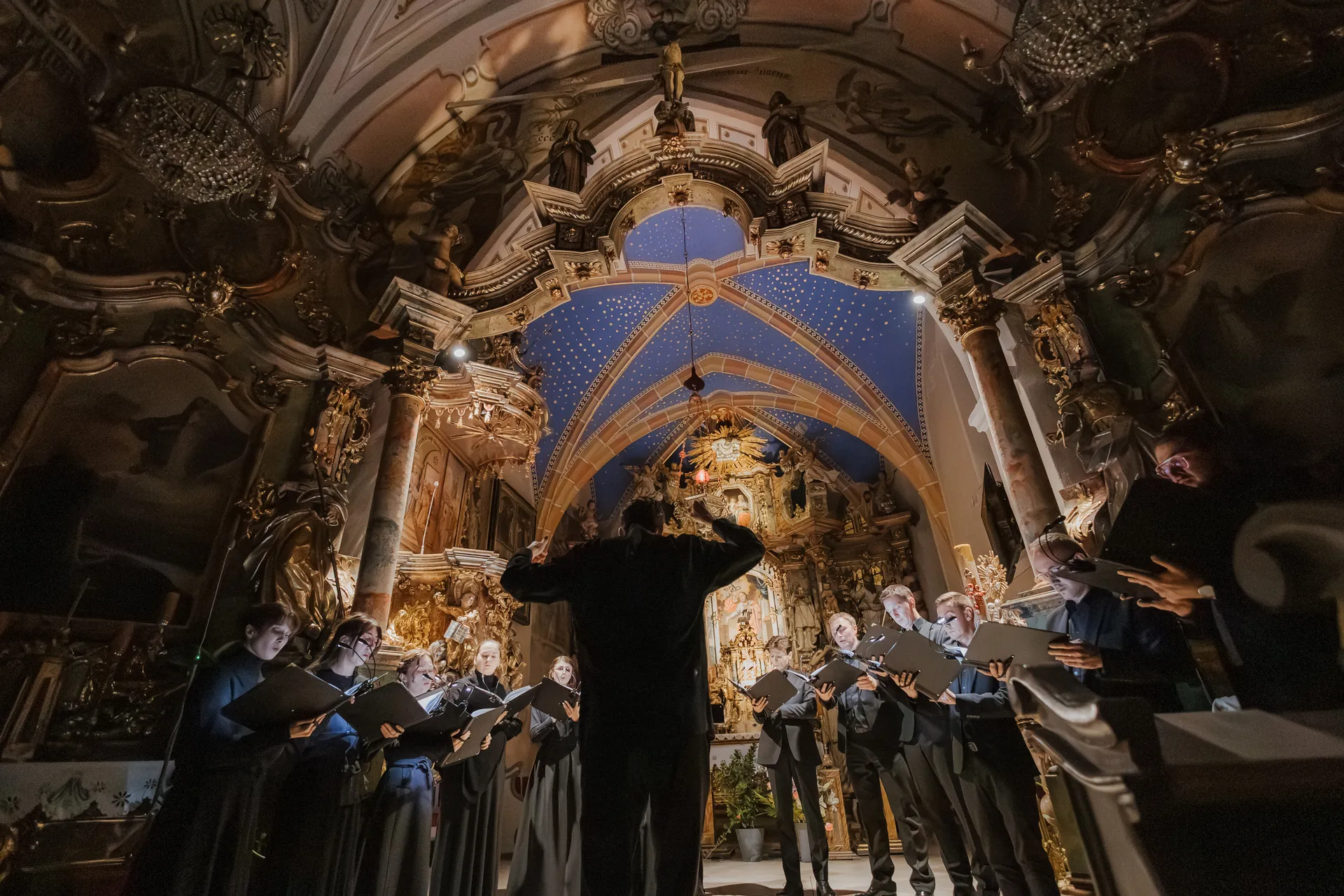
Image V Lamentum
Aeternam — Epitaph for Gaza
Requiem aeternam dona eis, Domine, et lux perpetua luceat eis Eternal rest grant unto them, O Lord, and let perpetual light shine upon them Requiem Introit
Ante concentum The threshold of the evening
The fourteenth of September 2025, the lower church in Mistrzejowice. The feast of the Exaltation of the Holy Cross, on the eve of the memorial of Our Lady of Sorrows. The ensemble asks for one thing: that the evening sound out in silence, as a single work.
Itinerarium Performances
- 14 September 2025 Kościół św. Maksymiliana Marii Kolbego (dolny kościół), Mistrzejowice, Kraków 18:00
- 18 October 2025 Kościół św. Bartłomieja Apostoła, Niedzica 18:00
Reflectio Reflection
“Epitaph for Gaza” is an act of prayer and a gesture of solidarity with wounded humanity in Gaza. Standing before the suffering of its people, we look in music for the purest language of compassion — believing that contemplation, silence and song can carry both the pain and the light of hope where words are no longer enough.
VoctEnsemble · September 2025
The programme takes a road Christianity has known for centuries: from the prayer at the grave, through a mother's lament and a plea for peace, through the image of the Passion, to the commending of everything to her who stood beneath the cross.
Programma The concert programme
A prayer in music: nine links and an encore
- Conductor
- Florent de Bazelaire
- Cello
- Joanna Indyk
- String quartet
- Paulina Niemiec · Maria Tur · Magdalena Prześlica · Joanna Indyk
The order here is a prayer. The evening opens with the words the Church sings over a grave, and immediately afterwards it goes as low as one can go: to a mother's cry over her killed children. From there it leads through three pleas for peace and through the weight of the cross, as far as the place where even the swallow has a nest, and to the last refrain, in which all creation rejoices.
-
Epitaphium Epitaph
The evening begins where speech ends: with words that have been sung over graves for centuries.
- 01
Bernat Vivancos · ur. 1973
Aeternam
the Introit of the Mass for the dead
Text and translation
A movement from the Requiem of the Catalan composer, for years attached to the Escolania de Montserrat boys' choir. Its foundation is the Introit of the Mass for the dead, words said over graves for centuries. Vivancos sets contemporary heterophony beside the plainness of old chant.
Requiem æternam dona eis, Domine, et lux perpetua luceat eis.
Eternal rest grant unto them, O Lord, and let perpetual light shine upon them.
-
Ploratus Lament of the innocents
Rachel weeping for her children: in the biblical tradition, the figure of every mother whose child has been taken from her.
- 02
Mikołaj Zieleński · 1560–1620
Vox in Rama
Mt 2:18
Text and translation
A motet from the collection Communiones totius anni, published in Venice in 1611. Zieleński set this text — a verse of Jeremiah taken up in Matthew's Gospel — so that the overlapping voices themselves become a cry. Rachel, the mother of Joseph and Benjamin, is in the biblical tradition the figure of the mother mourning every innocent victim; the motet was sung in the liturgy of the Holy Innocents.
Vox in Rama audita est, ploratus et ululatus multus. Rachel plorans filios suos, noluit consolari, quia non sunt.
In Rama was there a voice heard, lamentation and great mourning. Rachel weeping for her children, and would not be comforted, because they are not.
-
Oratio pro pace Prayer for peace
Three pleas from three corners of Europe: an antiphon written after the Madrid bombings, a Norwegian consolation with cello, a Ukrainian cry to the Mother of God.
- 03
Arvo Pärt · ur. 1935
Da pacem Domine
a medieval antiphon
Text and translation
Written at Jordi Savall's request three days after the Madrid bombings of 11 March 2004. Pärt set a medieval antiphon in his tintinnabuli style, the style he found after ten years of creative silence. The simple formula returns here like breathing: it lasts, instead of leading to a climax.
Da pacem, Domine, in diebus nostris, quia non est alius, qui pugnet pro nobis, nisi tu, Deus noster.
Give peace, O Lord, in our time, because there is none other that fighteth for us, but only thou, O God.
- 04
Ola Gjeilo · ur. 1978
Serenity
O magnum mysterium a responsory of Christmas
Text and translation
The Norwegian composer set the responsory O magnum mysterium for choir and solo cello. The voice of the instrument, so often compared to the human one, holds an intimate dialogue with the choir. The text speaks of a birth; in this programme, of the birth of the Prince of Peace.
O magnum mysterium, et admirabile sacramentum, ut animalia viderent Dominum natum, iacentem in praesepio: Beata Virgo, cujus viscera meruerunt portare Dominum Christum. Alleluia.
O great mystery and wondrous sacrament, that the animals should see the newborn Lord lying in a manger. O blessed Virgin, whose womb was worthy to bear Christ the Lord. Alleluia.
- 05
Hanna Havrylets · 1958–2022
Prayer · Молитва до Пресвятої Богородиці
A Prayer to the Most Holy Mother of God
Text and translation
The composer, a pupil of Myroslav Skoryk, was one of the leading figures of contemporary Ukrainian music. She died in Kyiv in 2022, in the first days of the Russian invasion, when access to medical care was restricted. Her prayer to the Mother of God, built on simple melodic lines, sounds today like a testimony.
Пресвятая Богородице, вислухай нас. Пресвятая Богородице, будь нам заступницею. Всесильною Твоєю рукою допоможи нам Перемогти ворогiв, що напали.
Most holy Mother of God, hear us. Most holy Mother of God, be our advocate. With thy almighty hand help us to overcome the enemies who have fallen upon us.
-
Videns civitatem, flevit super illam: Si cognovisses et tu, quæ ad pacem tibi!
When he beheld the city, he wept over it: If thou hadst known the things which belong unto thy peace!
Lk 19:41–42 -
Passio Image of the Passion
At the midpoint of the evening: the weight of the cross, written out in the chromaticism of eight voices.
- 06
Antonio Lotti · 1667–1740
Crucifixus
from the Creed of the Mass
Text and translation
A fragment of the Creed from a mass by Lotti, who worked in Venice at the turn of the seventeenth and eighteenth centuries. Many settings of this text by him survive, for various forces; the eight-voice version is among the most affecting. The chromatic movement of the voices and the dense texture make an image of the weight of the cross: Baroque expression subordinated to the theology of the Passion.
Crucifixus etiam pro nobis sub Pontio Pilato: passus, et sepultus est.
And was crucified also for us under Pontius Pilate: he suffered and was buried.
-
Refugium Refuge
After the Passion the smallest image the Psalter knows returns: the sparrow and the swallow that find a nest beside the altar.
- 07
Caroline Shaw · ur. 1982
and the swallow
Ps 84:2–4, 7
Text and translation
The American composer, a Pulitzer Prize winner, wrote this piece to a commission from the Nederlands Kamerkoor for its “150 Psalms” series. Its chamber forces and light texture set it apart from the rest of the programme: instead of a lament comes an image of the smallest creatures, which find a nest beside the altar. The ensemble closed the announcement of the evening with the same psalm — with the hope that a day will come when anyone can say “How amiable are thy dwellings, O Lord of hosts”.
How beloved is your dwelling place, o lord of hosts. My soul yearns, my heart and my flesh cry [out]. The sparrow found a house, and the swallow her nest, where she may raise her young. They pass through the Valley of Bakka, they make it a place of springs; the autumn rains cover it with pools.
-
Commendatio Commendation
What remains is the commending of everything to her who stood beneath the cross, and the promise the last refrain carries.
- 08
John Tavener · 1944–2013
Mother of God, here I stand
text: Mikhail Lermontov
Text and translation
Part of the monumental cycle The Veil of the Temple, first performed at the Temple Church in London in 2003; the text comes from the poetry of Mikhail Lermontov. The music stands completely still, without a climax, like an icon in sound. In this programme the silence is the climax: a gesture commending the victims of Gaza.
Mother of God, here I stand now praying, Before this icon of your radiant brightness, Not praying to be saved from a battlefield; Not giving thanks, nor seeking forgiveness For the sins of my soul, nor for all the souls Numb, joyless and desolate on earth; But for THEM alone, whom I wholly give you.
- 09
John Tavener · 1944–2013
A Hymn to the Mother of God
a text from the Byzantine liturgy
Text and translation
One of Tavener's best known choral works, written in memory of his mother, to a text from the Byzantine liturgy. The composer sets two six-voice choirs side by side, and their overlapping phrases create resonance and space: a dialogue between earth and heaven. The last refrain carries the evening from pain towards a promise.
In you, O Woman full of grace, the angelic choirs and the human race, all creation rejoices. O sanctified temple, mystical paradise, glory of virgins, in you God was made flesh and became a child, He who is our God before all ages. He made your womb a throne, and made it wider than the heavens. In you, O Woman full of grace, all creation rejoices. Glory to you.
- bis
Rihards Dubra · ur. 1964
O crux, ave
from the hymn Vexilla regis · Venantius Fortunatus (6th century)
Text and translation
The Latvian composer set a fragment of the hymn Vexilla regis by Venantius Fortunatus (6th century). It is the hymn of the feast of the Exaltation of the Holy Cross — the very day on which the ensemble sang this programme for the first time. A plain, almost archaic texture closes the evening with a plea for forgiveness.
O crux, ave, spes unica, hoc passionis tempore: auge piis justitiam, reisque dona veniam.
O Cross, our one reliance, hail! This holy Passiontide, avail to give fresh merit to the saint, and pardon to the penitent.
The instrumental interludes differed between the two evenings: in Mistrzejowice a string quartet played Arvo Pärt's Psalom, in Niedzica Joanna Indyk played movements from Bach's cello suites. The list above covers the links common to both performances.
Latin and original texts from the ensemble's own programmes; English translations our own.
Where civilians, children and families carry the marks of war upon them, we ask: what are justice, memory and mercy today? What inscription should be cut on the grave of Gaza?
VoctEnsemble from the announcement of the concert
Voces Voices of the evening
- Soprano I
- Maria Marczewska
- Karolina Grodecka
- Soprano II
- Katarzyna Rogal
- Joanna Kosiba
- Alto I
- Natalia Czajkowska
- Alto II
- Izabela Bartyzel-Gajówka
- Alto III
- Anna Marcisz
- Tenor I
- Bartłomiej Chorąży
- Tenor II
- Mateusz Solarz
- Tenor III
- Michał Jan Barański
- Bass I
- Dawid Janowiak
- Adam Dawiec
- Bass II
- Szymon Maziarz
- Jakub Ciępka
- Conductor
- Florent de Bazelaire
The line-up of the evening in Mistrzejowice, 14 September 2025, after the ensemble's press note.
Imago viva The evening on film
Imagines Images of the evening
St Maximilian Kolbe's Church, Mistrzejowice 14 September 2025
St Bartholomew's Church, Niedzica 18 October 2025
Photographs: the ensemble's own archive
Images from every evening