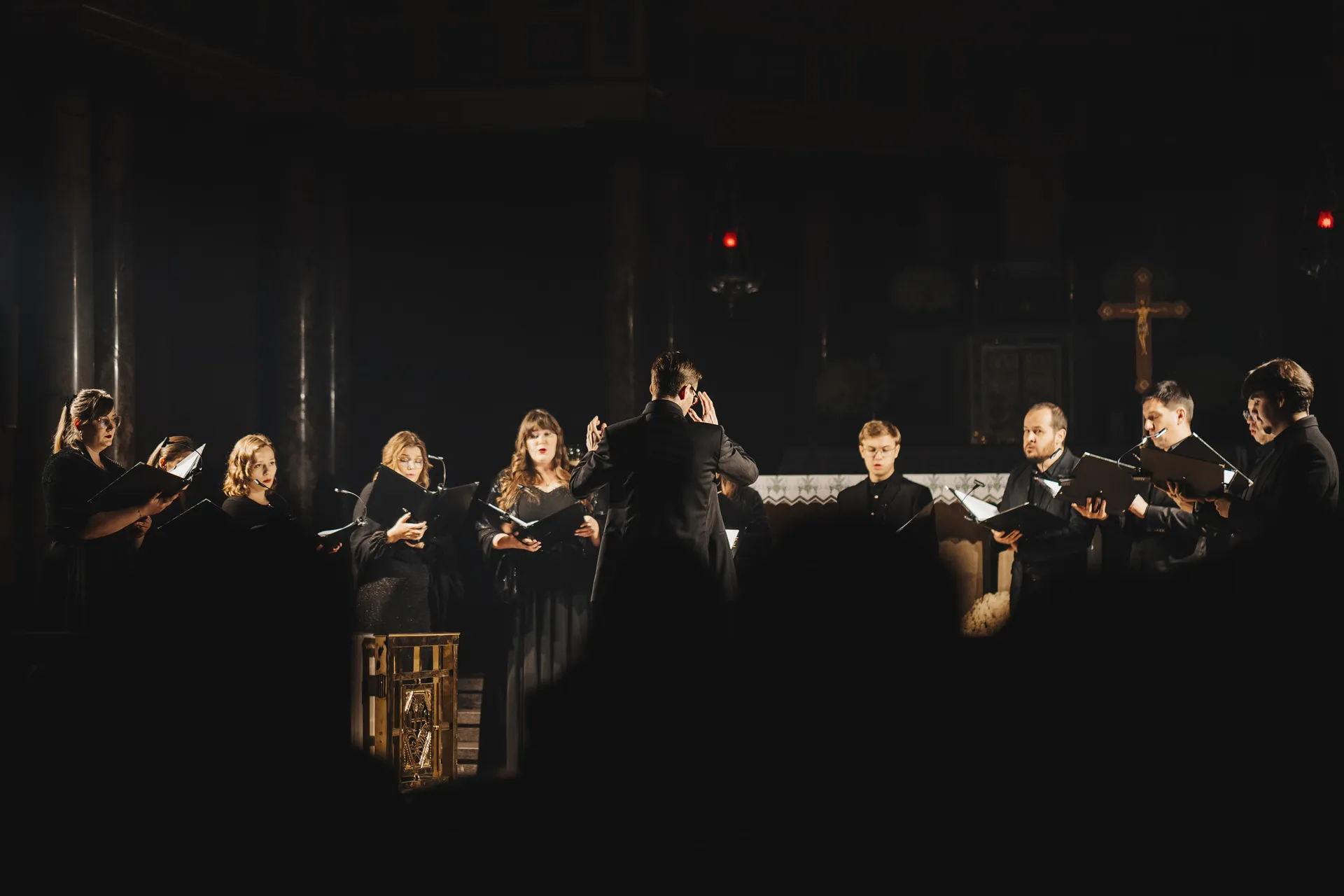
Image I Incarnatio
Contemplation of the Incarnation
Et egredietur virga de radice Iesse And there shall come forth a rod out of the stem of Jesse Is 11:1
Ante concentum The threshold of the evening
The twentieth of January, evening, the Basilica of the Sacred Heart of Jesus in Kraków. Twenty days after the ensemble came into being. Before the first sound, Fr Jarek Naliwajko SJ leads the audience into the mystery of the Incarnation.
Verbum The opening word
Uncovering a mystery always ends the same way. It leads to another mystery. Otherwise it is not a mystery at all, but knowledge, or routine.
Fr Jarek Naliwajko SJ · 20 January 2024
The whole of the opening word
Good evening, and God bless you. I warmly welcome everyone who has come to our church, to the Basilica of the Sacred Heart of Jesus.
Ladies and gentlemen, this evening, with this inaugural concert, the performers wish to invite us into the still unsettling world of the spirit — a world which urges the performers themselves, the authors of tonight's meeting, towards a kind of inner movement, towards casting that disquiet out of themselves: that is, towards the necessity of telling of the mystery of the spirit.
Because for the time being — that is, for some two hundred thousand years — humanity has come up with no better word for that intriguing part of our own immersion in time, the part we have never fully recognised. No better word than spirit has been invented. They want to let us in on a mystery. And yet uncovering a mystery always ends the same way. It leads to another mystery. Otherwise it is not a mystery at all, but knowledge, or routine — so adored by some, and so often mistaken for life.
But let us begin with the poster for tonight's concert; it should be showing on our screens. A cobalt ground, and across it white rays spreading outwards — do notice this — or else converging inwards, rays made of letters that form words. They are converging or departing, or arriving, but the direction is the viewer's to decide, because in life one either descends towards the centre or goes out, moves away from the centre, in which there is nothing but that very cobalt or indigo ground behind a small white spot — as on this poster.
And these three colours are associated with the symbol of the highest spirituality — in Indian anthropology, for instance: indigo is the highest chakra, the one that joins us to the spirit of the universe, just as white does in our own tradition, where it belongs to the Absolute. Following that thread further: indigo and cobalt were used to dye royal robes, and so the robes of the anointed of God.
Democracy — unfortunately and fortunately — has made us all equal; though what has really done it is the routine of democracy, or rather: democracy is routine. Tonight, however, the performers wish to lead us out of the comfort of the everyday, in which routine has taken us over and given us an illusory sense of safety, of a certain equality — because routine is surely the sister of forgetting the world of the spirit.
The performers are proposing that we meet the Incarnation once again. They lead us out of routine in order to lead us into the Incarnation. And yet in the moment I speak that word and it turns into a sound wave, I strip the Incarnation of all its boundlessness. It becomes apparently comprehensible, and by that entirely untrue — blurred, certainly, because it has been stripped of its mystery. The Incarnation flows out and flows in at once — like those rays on the poster: from the source it flows out to us, and with us it flows back into the centre.
A spiritual concert — for that is the subtitle its authors have given to this whole cycle, of which we too will be not only witnesses but, in some sense, makers — is the first scene. Tonight is nothing other than a meeting with oneself, if only we consent to that inner movement of ours, and so discover that we are not alone, neither within ourselves nor around us, and that fullness is trying to find an utterance which crosses boundaries rather than blurring them, and finds it precisely through music.
And finally, a request from the performers: please do not applaud during the programme. We give ourselves over entirely to a suspension of awareness and let ourselves be moved only as the waves of a boundless ocean are moved. We listen, and let nothing in us be active but our attentiveness to the spirit. And so let us welcome tonight's performers.
Then the murmur dies away, and out of the winter half-light rises Sandström's rod.
A transcript of the opening word, lightly edited for readability.
Reflectio Reflection
The Incarnation is something unutterable, which with the passing of time often becomes ordinary to us. When we grasp what this mystery means, we can recover our sense of God's presence in our lives.
Florent de Bazelaire · 20 January 2024
Programma The concert programme
Ten glances
- Conductor
- Florent de Bazelaire
- Introductory word
- o. Jarek Naliwajko SJ
- Production
- Ars Sonora Studio
The order is part of the composition here. The evening runs like the history of salvation: from the rod of Isaiah's prophecy, through the shepherds' night watch and Gallus's Advent trumpet, to the birth itself. Then a Marian contemplation, and after it a sudden shadow: a mother's lullaby over a child condemned by Herod. The Canticle of Simeon closes it in the temple: “mine eyes have seen thy salvation”. This is the fulfilment of the promise the programme began with; from here there is only praise, and the joy of the encore.
-
Prophetia Prophecy
Before a word is said of the Child, the promise sounds: a rod from the stem of Jesse, the shepherds' cry in the night, the Advent trumpet announcing the coming.
- 01
Jan Sandström · 1942–2019
Es ist ein Ros' entsprungen
Et egredietur virga de radice Iesse And there shall come forth a rod out of the stem of Jesse (Is 11:1)
Text and translation
A German carol from the end of the sixteenth century (Trier, 1587), first printed in a Jesuit hymnal from Speyer (1599). Its twenty-three stanzas run through the whole of sacred history, from Isaiah's prophecy to the adoration of the Magi: the very road this programme is about to travel. In English it is known as “Lo, how a rose e'er blooming”, in Theodore Baker's translation of 1894. Sandström weaves the old chorale around a quartet of soloists floating above it.
Es ist ein Ros' entsprungen aus einer Wurzel zart, wie uns die Alten sungen, von Jesse kam die Art und hat ein Blümlein bracht mitten im kalten Winter, wohl zu der halben Nacht.
Lo, how a rose e'er blooming from tender stem hath sprung, of Jesse's lineage coming as men of old have sung. It came, a flow'ret bright, amid the cold of winter, when half spent was the night.
- 02
Bernat Vivancos · ur. 1973
Le cri des bergers
Pastores erant in regione eadem vigilantes Shepherds keeping watch over their flock by night (Lk 2:8)
About the work
The cry of shepherds keeping watch over their flock by night. In Vivancos it is a lost melody of solitude which, listening into the “echo of silence”, is transformed into beauty. Twelve voices written out across the whole space of the nave.
- 03
Jacob Handl (Gallus) · 1550–1591
Canite tuba
Canite tuba in Sion · Ecce Deus salvator noster adveniet Blow the trumpet in Zion · Behold, God our Saviour shall come (Zech 9:14)
Text and translation
An Advent motet for five voices on words of the prophet Zechariah. The Renaissance counterpoint of Gallus, a Slovene from the circle of imperial music, announces the coming like the sound of a trumpet: “Behold, God our Saviour shall come”.
Canite tuba in Sion, vocate gentes, annuntiate populis et dicite: Ecce Deus salvator noster adveniet. Annuntiate et auditum facite, loquimini et clamate: Ecce Deus salvator noster adveniet.
Blow the trumpet in Zion, call the nations, proclaim it to the peoples and say: Behold, God our Saviour shall come. Proclaim it and make it known, speak and cry aloud: Behold, God our Saviour shall come.
-
Nativitas Nativity
The Child comes. Around him gathers his Mother's contemplation: Renaissance Spain and a Polish carol.
- 04
Bernat Vivancos · ur. 1973
A Child is born
text: H. M. MacGill (1876)
About the work
A simple contemporary carol for four voices, to a poem by H. M. MacGill of 1876. After the prophecies comes the birth itself.
- 05
Tomás Luis de Victoria · 1548–1611
Alma Redemptoris Mater
Alma Redemptoris Mater Gracious Mother of the Redeemer · Marian antiphon
About the work
The Marian antiphon of Advent, sung from 1 December to 2 February. Victoria's motet for eight voices: eight independent lines hold a dialogue akin to the Venetian coro spezzato, although the composer himself left no instruction about placing the choir in space.
- 06
Krzysztof Penderecki · 1933–2020
O gloriosa Virginum
O gloriosa Virginum O most glorious of virgins
About the work
Penderecki wrote this piece in 2009 for the seventieth birthday of José Antonio Abreu, founder of Venezuela's El Sistema. It was first performed in Caracas under the composer's own baton; the Polish premiere followed a few days later.
- 07
Mariusz Kramarz
Gdy śliczna Panna
a contemporary arrangement of a Polish carol
About the work
A Polish carol arranged by Mariusz Kramarz: a native voice in this international programme, immediately after the contemporary nativity.
-
Vox in Rama audita est, ploratus et ululatus: Rachel plorans filios suos.
In Rama was there a voice heard, lamentation and great mourning: Rachel weeping for her children.
Jer 31:15 · Mt 2:18 -
Umbra Shadow
Just after the birth a shadow falls: a mother's lullaby over a child Herod has condemned.
- 08
Philip Stopford · ur. 1977
Lully, Lullay
Coventry Carol — Rzeź Niewiniątek a mother's lullaby for a condemned child · Mt 2:16
Text and translation
The Coventry Carol comes from the sixteenth-century mystery play “The Shearmen and Tailors”. It is a lullaby sung in the mother's voice over a condemned child: the shadow of the Massacre of the Innocents, falling immediately after the birth. Stopford clothed it in cool contemporary harmony in 2008.
Lully, lullay, thou little tiny child, bye, bye, lully, lullay. Lullay, thou little tiny child, bye, bye, lully, lullay. O sisters too, how may we do for to preserve this day this poor youngling for whom we do sing: bye, bye, lully, lullay? Herod the king, in his raging, charged he hath this day his men of might, in his own sight, all young children to slay. That woe is me, poor child, for thee! And ever mourn and sigh, for thy parting neither say nor sing: bye, bye, lully, lullay.
-
Impletio Fulfilment
In the temple Simeon takes the Child in his arms: “mine eyes have seen thy salvation”. The promise from the start of the evening is fulfilled.
- 09
Arvo Pärt · ur. 1935
Nunc dimittis
Nunc dimittis servum tuum, Domine Lord, now lettest thou thy servant depart in peace · the Canticle of Simeon (Lk 2:29–32)
Text and translation
The Canticle of Simeon from the Presentation in the temple: “mine eyes have seen thy salvation”. In Pärt, in his tintinnabuli, it is the fulfilment of the promise the evening began with; the old man may depart in peace.
Nunc dimittis servum tuum, Domine, secundum verbum tuum in pace, quia viderunt oculi mei salutare tuum, quod parasti ante faciem omnium populorum: lumen ad revelationem gentium et gloriam plebis tuae Israel.
Lord, now lettest thou thy servant depart in peace, according to thy word. For mine eyes have seen thy salvation, which thou hast prepared before the face of all people; to be a light to lighten the Gentiles, and to be the glory of thy people Israel.
-
Laus Praise
All that remains is a new song and joy: Christ is born.
- 10
Claudio Monteverdi · 1567–1643
Cantate Domino
Cantate Domino canticum novum O sing unto the Lord a new song (Ps 98 (97))
About the work
A motet for six voices, published in 1620 in a collection by Giulio Cesare Bianchi. A joyful triple metre opens it: four voices first, then at once the full six. It runs through interwoven verses of Psalms 96 and 98 — a call to a new song whose joy is audible in the texture itself.
- bis
Anonim / aranż. Brian Kay
Gaudete
Gaudete, gaudete! Christus est natus Rejoice! Christ is born
Text and translation
A carol from the Finnish-Swedish collection of sacred songs Piae Cantiones (1582), arranged by Brian Kay. Joy as an encore: “Christ is born”, the last word of the evening.
Gaudete, gaudete! Christus est natus ex Maria virgine, gaudete! Tempus adest gratiæ, hoc quod optabamus; carmina lætitiæ devote reddamus. Deus homo factus est, natura mirante; mundus renovatus est a Christo regnante. Ezechielis porta clausa pertransitur; unde lux est orta, salus invenitur. Ergo nostra concio psallat iam in lustro; benedicat Domino: salus Regi nostro.
Rejoice, rejoice! Christ is born of the Virgin Mary, rejoice! The time of grace has come that we have longed for; let us render songs of joy in devotion. God is made man, and nature marvels; the world is renewed by Christ the King. The closed gate of Ezekiel has been passed through; whence the light has risen, there salvation is found. Therefore let our assembly sing now in brightness; let it bless the Lord: honour to our King.
Latin and original texts from the ensemble's own programmes; English translations our own.
Voces Voices of the evening
- Sopranos
- Liliana Pociecha
- Marta Migut
- Altos
- Natalia Czajkowska
- Olga Bodnar
- Tenors
- Michał Ryguła
- Paweł Żurawski
- Basses
- Dawid Janowiak
- Szymon Maziarz
- Solo quartet
- Maria Marczewska
- Hanna Mikołajun
- Mikołaj Niżegorodcew
- Jakub Ciępka
- The quartet floating above the chorale in Es ist ein Ros' entsprungen; in Le cri des bergers it completes the twelve voices.
- Conductor
- Florent de Bazelaire
Neither the performers nor the organisers took a fee for this evening; the debut was supported by a public collection raised around the newly formed ensemble.
Imago viva The evening on film
Imagines Images of the evening
Rehearsal
Sacred Heart Basilica, Kraków 20 January 2024
Photographs: Tomasz Czajkowski · the ensemble's own archive
Images from every evening