Image III Psalmi
Nine Leaves from the Book of Psalms
Miserere mei, Deus, secundum magnam misericordiam tuam Have mercy upon me, O God, after thy great goodness Ps 51
Ante concentum The threshold of the evening
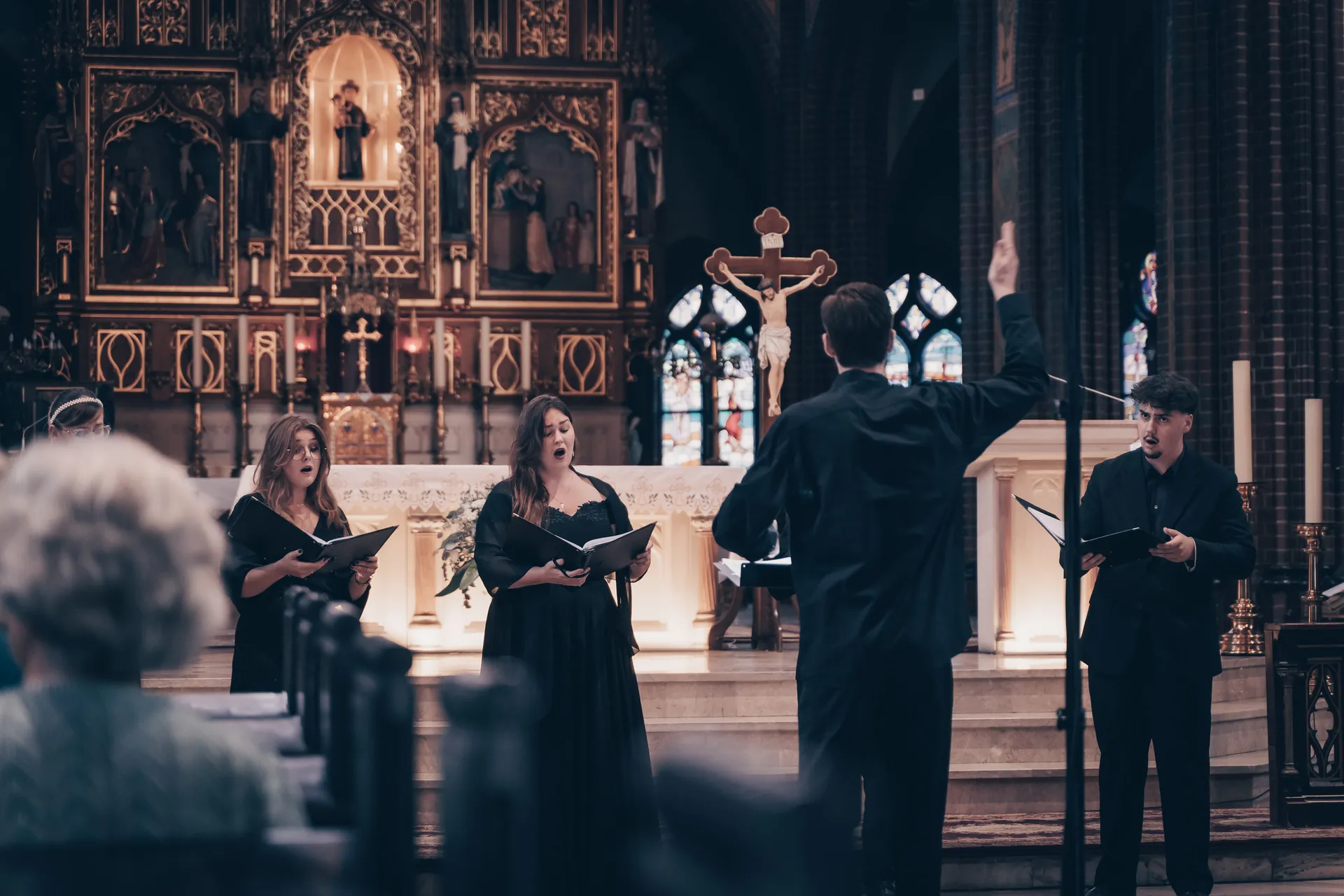
The sixteenth of November 2024, the Sacred Heart Basilica in Kraków. The third evening of this programme, after Rybnik and Łódź. Before the first sound, Fr Przemysław Wysogląd SJ sets out the context of the psalms, and Ada Bystrzycka's light sculpts the space. The ensemble asks for one thing: not to applaud the individual pieces, and to keep the silence between them.
Itinerarium Performances
- 8 September 2024 Bazylika św. Antoniego, Rybnik 16:30
- 17 September 2024 Archikatedra, Łódź 19:00
- 16 November 2024 Bazylika NSPJ, ul. Kopernika 26, Kraków 20:00
Reflectio Reflection
The Psalter lays feelings side by side: a complaint next to a thanksgiving, a plea for mercy next to a summons to dance. The nine leaves of this evening were chosen for exactly that span, and clasped together by one penitential prayer that returns nine times.
Programma The concert programme
Nine psalms, entwined with the Miserere
- Conductor
- Florent de Bazelaire
- Introductory word
- o. Przemysław Wysogląd SJ
- Lighting design
- Ada Bystrzycka
Beside the list of works the ensemble added two words: “order matters”. The evening begins with penitence — Allegri's Miserere, Psalm 51 — and immediately interrupts it: the psalm is cut into nine parts, and between them come glory, wisdom, the law, joy, the throne, thanksgiving and a new song, each in turn. The penitent will not finish his prayer until every other voice of the Psalter has sounded; only after the last does he return for the ninth time and say it to the end. As in a life, in which sorrow and joy are interwoven.
- 01
Gregorio Allegri · 1582–1652
Miserere mei, Deus
Miserere mei, Deus, secundum magnam misericordiam tuam Have mercy upon me, O God, after thy great goodness (Ps 51 (50))
About the work
A penitential psalm sung in the Sistine Chapel at Tenebrae in Holy Week. The Vatican guarded this music: taking a copy out carried the threat of excommunication, and the soloists' ornamented lines were passed on by ear, from one generation to the next. The fourteen-year-old Mozart heard it in 1770 and wrote it down from memory. Here the work is divided into nine parts which wind around the other psalms: a five-voice choir leads verse by verse, and four soloists answer it from a distance — hence the echo.
- Miserere — part I
Miserere mei, Deus, secundum magnam misericordiam tuam; et secundum multitudinem miserationum tuarum, dele iniquitatem meam. Amplius lava me ab iniquitate mea, et a peccato meo munda me.
Have mercy upon me, O God, after thy great goodness: according to the multitude of thy mercies do away mine offences. Wash me throughly from my wickedness: and cleanse me from my sin.
- 02
Orlando di Lasso · 1532–1594
Laudate Dominum omnes gentes
Laudate Dominum omnes gentes O praise the Lord, all ye nations (Ps 117)
Text and translation
Psalm 117 is the shortest in the whole Psalter: two verses, a summons addressed to all the nations. Lassus — a Fleming attached from 1556 to the Bavarian court in Munich, and the author of more than two thousand works — set them for twelve voices in choirs that answer one another: the shortest text of the evening is given its largest forces. After the first part of the Miserere the penitent falls silent, and the whole earth speaks.
Laudate Dominum omnes gentes, laudate Dominum omnes populi. Quoniam confirmata est super nos misericordia eius, et veritas Domini manet in aeternum.
O praise the Lord, all ye nations: praise him, all ye peoples. For his merciful kindness is ever more and more towards us: and the truth of the Lord endureth for ever.
- Miserere — part II
Quoniam iniquitatem meam ego cognosco, et peccatum meum contra me est semper. Tibi soli peccavi, et malum coram te feci: ut justificeris in sermonibus tuis, et vincas cum judicaris.
For I acknowledge my faults: and my sin is ever before me. Against thee only have I sinned, and done this evil in thy sight: that thou mightest be justified in thy saying, and clear when thou art judged.
- 03
Anton Bruckner · 1824–1896
Os justi, WAB 30
Os justi meditabitur sapientiam The mouth of the righteous is exercised in wisdom (Ps 37:30–31)
Text and translation
A gradual written for Ignaz Traumihler, choirmaster of the abbey of St Florian — the abbey in whose crypt, beneath the organ, Bruckner later asked to be buried. The composer set himself a rule as strict as the law the psalm speaks of: not one sharp, not one flat, no seventh chords, everything in the pure Lydian mode. He boasted of it to Traumihler in a letter. After the second part of the Miserere, in which the penitent acknowledges his fault, comes the portrait of a righteous man.
Os justi meditabitur sapientiam: et lingua ejus loquetur judicium. Lex Dei ejus in corde ipsius: et non supplantabuntur gressus ejus. Alleluia.
The mouth of the righteous is exercised in wisdom: and his tongue will be talking of judgement. The law of his God is in his heart: and his goings shall not slide. Alleluia.
- Miserere — part III
Ecce enim in iniquitatibus conceptus sum, et in peccatis concepit me mater mea. Ecce enim veritatem dilexisti; incerta et occulta sapientiae tuae manifestasti mihi.
Behold, I was shapen in wickedness: and in sin hath my mother conceived me. But lo, thou requirest truth in the inward parts: and shalt make me to understand wisdom secretly.
- 04
Charles Villiers Stanford · 1852–1924
Beati quorum via, op. 38 nr 3
Beati quorum via integra est Blessed are those that are undefiled in the way (Ps 119:1)
Text and translation
Psalm 119 is the longest in the Psalter: a hundred and seventy-six verses about the Law of God. Stanford takes one of them, the first. The motet was written for the choir of Trinity College, Cambridge, where the composer was organist, and appeared in 1905 in a set of three Latin motets. Six voices divide into two groups of three which hand the same phrase to one another; the way the psalm speaks of can be heard here.
Beati quorum via integra est, qui ambulant in lege Domini.
Blessed are those that are undefiled in the way: and walk in the law of the Lord.
- Miserere — part IV
Asperges me hyssopo, et mundabor; lavabis me, et super nivem dealbabor. Auditui meo dabis gaudium et laetitiam, et exsultabunt ossa humiliata.
Thou shalt purge me with hyssop, and I shall be clean: thou shalt wash me, and I shall be whiter than snow. Thou shalt make me hear of joy and gladness: that the bones which thou hast broken may rejoice.
- 05
J. S. Bach · 1685–1750
Singet dem Herrn ein neues Lied, BWV 225
Singet dem Herrn ein neues Lied O sing unto the Lord a new song (Ps 149:1–3)
Text and translation
The best known of Bach's motets, written in Leipzig. Two four-voice choirs pass the verses of the psalm between them like a ball; the composer weaves together Psalm 149, a Lutheran chorale and verses of Psalm 150. It is the most joyful and the most difficult link of the evening, set exactly opposite the penitence of the Miserere. When Mozart heard this motet at St Thomas's in Leipzig in 1789 he is said to have exclaimed: “Now here at last is something one can learn from”, and asked for the parts to be laid out for him.
Singet dem Herrn ein neues Lied, die Gemeine der Heiligen sollen ihn loben. Israel freue sich des, der ihn gemacht hat. Die Kinder Zion sei'n fröhlich über ihrem Könige, Sie sollen loben seinen Namen im Reigen; mit Pauken und mit Harfen sollen sie ihm spielen.
O sing unto the Lord a new song: let the congregation of saints praise him. Let Israel rejoice in him that made him: and let the children of Sion be joyful in their King. Let them praise his Name in the dance: let them sing praises unto him with tabret and harp.
- Miserere — part V
Averte faciem tuam a peccatis meis, et omnes iniquitates meas dele. Cor mundum crea in me, Deus, et spiritum rectum innova in visceribus meis.
Turn thy face from my sins: and put out all my misdeeds. Make me a clean heart, O God: and renew a right spirit within me.
- 06
Orlando Gibbons · 1583–1625
O clap your hands
O clap your hands together, all ye people O clap your hands together, all ye people (Ps 47:2–5)
Text and translation
Gibbons, organist of the Chapel Royal, wrote this anthem for eight voices in 1622 as his doctoral exercise for Oxford; the text comes from Coverdale's psalter, the psalter of the English Prayer Book. Psalm 47 seats God on a throne amid shouting and trumpets, and the choir breaks into eight voices so that the crowd can be heard.
O clap your hands together, all ye people; O sing unto God with the voice of melody. For the Lord is high and to be feared; he is the great King of all the earth. He shall subdue the people under us, and the nations under our feet. He shall choose out an heritage for us, even the worship of Jacob, whom he loved.
- Miserere — part VI
Ne projicias me a facie tua, et spiritum sanctum tuum ne auferas a me. Redde mihi laetitiam salutaris tui, et spiritu principali confirma me.
Cast me not away from thy presence: and take not thy holy Spirit from me. O give me the comfort of thy help again: and stablish me with thy free Spirit.
- 07
Salomone Rossi · 1570–1630
Barukh habba beshem Adonai
Barukh haba b'shem Adonai Blessed be he that cometh in the Name of the Lord (Ps 118:26–29)
Text and translation
Rossi was a Jew at the Gonzaga court in Mantua; the duke released him from the obligation to wear the yellow badge the others had to wear. In the collection “Ha-shirim asher li-Shlomo” (Venice) he was the first to apply Renaissance polyphony to Hebrew liturgical texts; the preface, defending part-singing in the synagogue, was written for him by Rabbi Leon of Modena. Here, in a programme built from psalms in Latin, German and English, their original language returns.
Baruch haba b'shem Adonai! B'rakhnuchém mi-beit Adonai. El Adonai, va-ya'er lanu! Isru-chag b'avotim ad karnot ha-mizbéach. Eli atah ve-odeka, Elohai, aromemeka. Hodu l'Adonai, ki tov, ki l'olam chasdo.
Blessed be he that cometh in the Name of the Lord! We have blessed you out of the house of the Lord. God is the Lord who hath shewed us light: bind the sacrifice with cords, yea, even unto the horns of the altar. Thou art my God, and I will thank thee: thou art my God, and I will exalt thee. O give thanks unto the Lord, for he is gracious: and his mercy endureth for ever.
- Miserere — part VII
Docebo iniquos vias tuas, et impii ad te convertentur. Libera me de sanguinibus, Deus, Deus salutis meae, et exsultabit lingua mea justitiam tuam.
Then shall I teach thy ways unto the wicked: and sinners shall be converted unto thee. Deliver me from blood-guiltiness, O God, thou that art the God of my health: and my tongue shall sing of thy righteousness.
- 08
Heinrich Schütz · 1585–1672
Jauchzet dem Herrn, alle Welt, SWV 36
Jauchzet dem Herren, alle Welt O be joyful in the Lord, all ye lands (Ps 100)
Text and translation
From the collection “Psalmen Davids” (Dresden, 1619), the first great work Schütz wrote after returning from Venice, where he had studied with Giovanni Gabrieli. He brought polychoral writing back with him and applied it to Luther's German psalter. Schütz was born exactly a hundred years before Bach; in this programme both their psalms sound in German and for two choirs, and the century between them can be heard.
Jauchzet dem Herren, alle Welt! Dienet dem Herren mit Freuden; kommt vor sein Angesichtt mit Frohlokken. Erkennet, daß der Herre Gott ist. Er hat uns gemacht und nicht wir selbst, zu seinem Volk und zu Schafen seiner Weide. Gehet zu seinen Toren ein mit Danken, zu seinen Vorhöfen mit Loben. Danket ihm, lobet seinen Namen! Denn der Herr ist freundlich, und seine Gnade währet ewig und seine Wahrheit für und für. Ehre sei dem Vater und dem Sohn und auch dem heilgen Geiste, wie es war im Anfang, jetzt und immerdar und von Ewigkeit zu Ewigkeit. Amen.
O be joyful in the Lord, all ye lands: serve the Lord with gladness, and come before his presence with a song. Be ye sure that the Lord he is God: it is he that hath made us, and not we ourselves; we are his people, and the sheep of his pasture. O go your way into his gates with thanksgiving, and into his courts with praise: be thankful unto him, and speak good of his Name. For the Lord is gracious, his mercy is everlasting: and his truth endureth from generation to generation. Glory be to the Father, and to the Son, and to the Holy Ghost; as it was in the beginning, is now, and ever shall be, world without end. Amen.
- Miserere — part VIII
Domine, labia mea aperies, et os meum annuntiabit laudem tuam. Quoniam si voluisses sacrificium, dedissem utique; holocaustis non delectaberis.
Thou shalt open my lips, O Lord: and my mouth shall shew thy praise. For thou desirest no sacrifice, else would I give it thee: but thou delightest not in burnt-offerings.
- 09
Claudio Monteverdi · 1567–1643
Cantate Domino
Cantate Domino canticum novum O sing unto the Lord a new song (Ps 98 (97))
Text and translation
A motet for six voices published in Giulio Cesare Bianchi's Milanese collection. The text is woven from two psalms — verses of 98 interlacing with a verse of 96 — and the summons it opens with had already been heard that evening, in Bach: O sing unto the Lord a new song. The ensemble closed the programme of “Contemplation of the Incarnation”, the concert the cycle began with, using this same motet; here it is the last word of praise before the ninth part of the Miserere.
Cantate Domino canticum novum, Cantate et benedicite nomini ejus: Quia mirabilia fecit. Cantate et exultate et psallite in cythara et voce psalmi: Quia mirabilia fecit.
O sing unto the Lord a new song: sing unto the Lord, and praise his Name; for he hath done marvellous things. Be glad and rejoice, and sing praises upon the harp and with the voice of a psalm, for he hath done marvellous things.
- Miserere — part IX + epilogue
Sacrificium Deo spiritus contribulatus; cor contritum et humiliatum, Deus, non despicies. Benigne fac, Domine, in bona voluntate tua Sion, ut aedificentur muri Jerusalem. Tunc acceptabis sacrificium justitiae, oblationes et holocausta; tunc imponent super altare tuum vitulos.
The sacrifice of God is a troubled spirit: a broken and contrite heart, O God, shalt thou not despise. O be favourable and gracious unto Sion: build thou the walls of Jerusalem. Then shalt thou be pleased with the sacrifice of righteousness, with the burnt-offerings and oblations: then shall they offer young bullocks upon thine altar.
- bis
Orlando Gibbons · 1583–1625
Drop, drop, slow tears
words: Phineas Fletcher
Text and translation
A poem by Phineas Fletcher — printed only in 1633, though it had circulated earlier — set to a melody by Gibbons from George Wither's book of church songs. The same hand that gave this evening its most triumphant psalm leaves it its last and quietest word. The ensemble asked for the Polish text to be shown on the screens during the encore: after nine parts of the Miserere, these tears were meant to be understood.
Drop, drop, slow tears, and bathe those beauteous feet which brought from Heaven the news and Prince of Peace. Cease not, wet eyes, his mercies to entreat; to cry for vengeance sin doth never cease. In your deep floods drown all my faults and fears; nor let his eye see sin, but through my tears.
The line-up of thirteen singers is recorded for the Kraków evening (16 November 2024); the ensemble had performed the same programme, in the same order, in Rybnik and in Łódź.
The texts follow the concert programme. The English of the psalms follows the Book of Common Prayer psalter — Coverdale's, the psalter Gibbons himself set — with the Authorised Version where Coverdale's wording has drifted out of use.
Imagines Images of the evening
St Anthony's Basilica, Rybnik 8 September 2024
Łódź Cathedral 17 September 2024
Sacred Heart Basilica, Kraków 16 November 2024
Photographs: Wojciech Przybył · Edyta Gonet · Jakub Garbacz · Kamila Grudzińska
Images from every evening